In the context of unpredictable climate change, water resource management requires precise decisions to balance safety, operating costs, and system resilience. The biggest challenge currently facing management agencies is the fragmentation of data across sensor systems, hydrological models, and inter-agency bodies. To address this, building a transparent decision-making process based on a Digital Twin platform is key to optimizing resources and minimizing operational risks.
Modern decision-making platforms are based on integrating multi-source data.
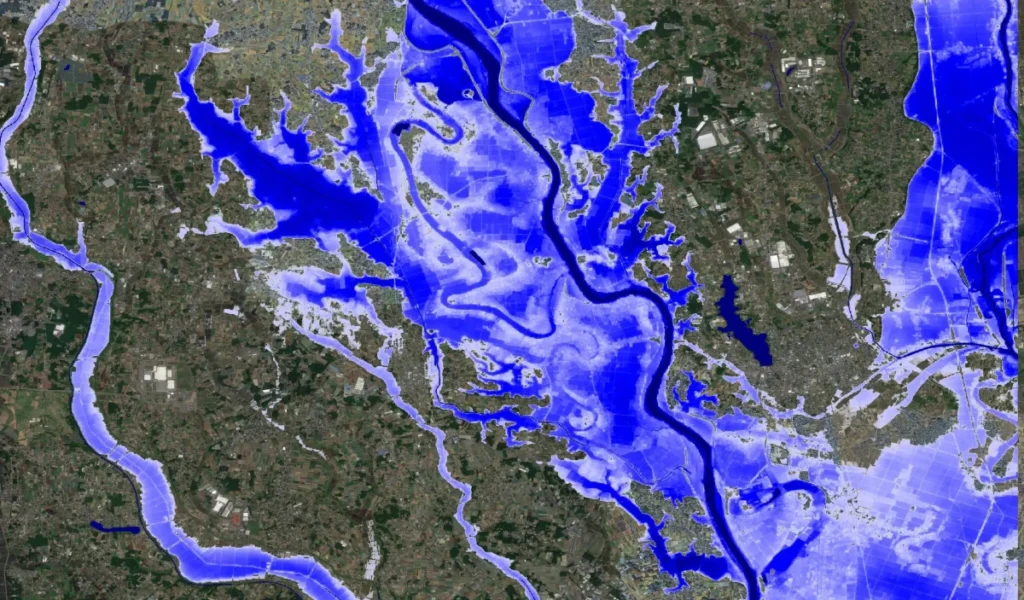
To minimize uncertainty, the Digital Twin system establishes a comprehensive and unified view by consolidating data streams. The system automatically feeds and standardizes data from telemetry, rainfall radar, meteorological forecasts, SCADA systems, and satellite data into a common data layer. Simultaneously, the platform operates a multi-model simulation chain, connecting hydrological, hydraulic, and water quality models to run automatically or on demand, supporting flood and drought risk forecasting. Scenario and impact analysis tools allow for comparison of operational strategies, infrastructure options, and climate scenarios, while the operational dashboard provides KPIs and decision support logic (DSS) intuitively for all stakeholders.
Collect – Detect – Decide framework: Managing the complexity of water systems
The Digital Twin solution is built on a robust operational structure and strategy, beginning with the collection and standardization process. This process utilizes data pipelines to feed all hydrological and environmental data into a unified Lakehouse environment. Here, the data is cleaned, transformed, and tagged, ensuring full transparency and traceability for audit or regulatory requirements.
Next is the risk detection phase through advanced analytics. The system runs multi-model simulations to identify early risks such as floods, droughts, or pollution spread. In particular, anomaly detection technology on the sensor network and rainfall modeling system helps to provide timely early warning signals from upstream watersheds to urban drainage systems.
Finally, the system supports confident action (Decide) by providing decision logic that suggests optimal actions such as controlling pumps, valves, or allocating storage capacity. The system prioritizes investment scenarios using multi-criteria decision analysis (MCDA) and automates operational processes with adaptive triggers, minimizing the risk of human error.
Strategic benefits and system resilience
The application of Digital Twin creates a “Decision Shield” that delivers outstanding practical value. The solution not only improves operational reliability by early detection of emerging risks but also optimizes costs through streamlined pumping, maintenance, and infrastructure investment sequences. Emergency response time is significantly shortened thanks to an automated and clear decision-making process. Furthermore, maintaining a “single source of truth” strengthens consensus among regulatory agencies, consultants, and stakeholders, thereby enhancing long-term adaptability to climate change scenarios.
Join the Digital Twin ecosystem from TECOTEC
We offer flexible deployment paths tailored to the specific capabilities of each organization. Clients can choose to support their internal teams by gaining full access to the API system and model pipeline, or leverage TECOTEC’s expert services for data architecture design and in-depth model calibration. With collaboration from Nelen & Schuurmans – a global leader in hydrodynamic modeling – our ecosystem ensures a comprehensive Digital Twin solution for sustainable and efficient water resource management.